
The 30-day patch cycle was designed around a specific threat assumption: that weaponizing a published CVE took weeks. Security teams had time to test, schedule through change advisory, and deploy in a controlled window. That assumption is no longer valid.
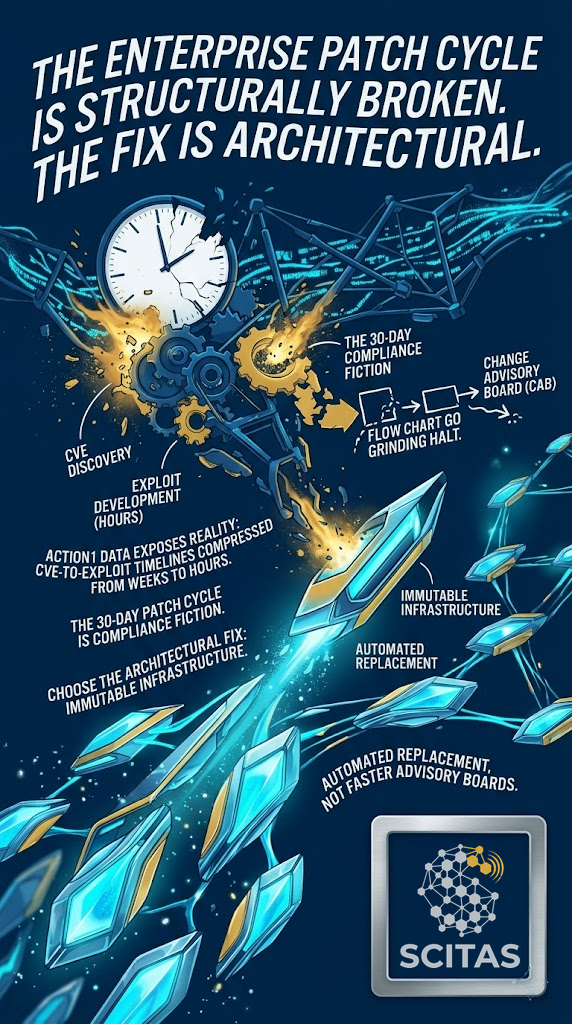
Action1’s 2024 vulnerability management report documents what security architects have observed empirically for the past two years. The median time from CVE publication to active exploitation has compressed to below 24 hours for critical severity vulnerabilities. For a subset of high-profile CVEs, weaponized exploit code is available on public repositories within hours of the NVD publication.
The 30-day patch cycle does not protect against that. It is a governance artefact from a different era.
What the 30-Day Cycle Was Actually Designed For
The monthly patching cadence emerged from two constraints that were real in the early 2000s. First, weaponization was slow. Nation-state actors and sophisticated criminal groups took weeks to convert a published vulnerability into a reliable exploit. A 30-day window still left a margin. Second, the cost of a failed patch was high. In-place patching on physical servers was destructive, rollback was manual, and an untested patch applied to a production database could mean hours of downtime. The CAB gate existed to enforce testing discipline before that risk was accepted.
Both constraints have inverted.
What the Action1 Data Shows
Action1’s data covers CVE exploitation timelines across enterprise environments. The report shows that the 2023-2024 cohort of critical CVEs saw active exploitation begin within 48 hours of NVD publication in 60% of cases. In the fastest instances, proof-of-concept code was incorporated into commodity attack frameworks the same day the CVE was disclosed.
This is not a tail risk scenario. It is the median case for critical infrastructure vulnerabilities.
A team running a monthly patch cycle with a two-week CAB queue is operating with a structural gap of 20 to 25 days. For any CVE published in that window, the estate is exposed and the governance process provides no protection. The change advisory board is meeting after the breach window has already opened.
Why Faster CABs Do Not Solve This
The instinct is to accelerate the existing process: shorten CAB cycles to weekly, create emergency change procedures, add a fast-track lane for critical CVEs. These interventions reduce latency at the governance layer, but governance latency is not the binding constraint.
The binding constraint is infrastructure mutability. In-place patching on mutable virtual machines requires: identify the patch, test it in a staging environment that approximates production, obtain change approval, schedule a maintenance window, apply the patch, verify, and monitor. Even on an emergency track, that process takes days, not hours. It takes days because the infrastructure was designed to be patched, not replaced.
Speeding up the approval step does not change the deployment architecture. A 72-hour emergency CAB track still cannot consistently patch a critical CVE before active exploitation begins.
What Immutable Infrastructure Actually Means
Immutable infrastructure flips the operational model. Instead of patching a running system, you replace it. The production workload runs on an image. When a CVE is identified, the base image is rebuilt with the patched dependency, validated through automated testing, and the fleet is rotated to the new image. The old instances are terminated.
There is no in-place modification. The system is never in a partially patched state. Rollback means redeploying the previous known-good image, which is a deterministic operation with a defined time cost.
The security property this delivers is not faster patching. It is the elimination of configuration drift and the guarantee that every running instance reflects the current validated image. Patches do not accumulate. The gap between desired and actual state is measured in hours, not months.
The Prerequisite: Infrastructure as Code
Immutable infrastructure is not a product category. It is an operational posture that requires a specific technical foundation: every infrastructure component must be defined in code and buildable from scratch on demand.
Infrastructure as Code (IaC) means your server configurations, network topology, security group rules, and deployment parameters exist as version-controlled source files. When you need to rebuild, you execute the code. The output is deterministic. A system built from IaC today produces the same result as the same code executed six months ago, absent deliberate version changes.
Without IaC, you cannot replace infrastructure reliably. You can only patch it in place, which returns you to the original problem.
The Transition Path for Mutable VM Fleets
Most enterprise estates reaching this problem in 2026 are running hybrid environments: some containerised workloads on Kubernetes, a larger body of traditional virtual machines that were provisioned manually and have accumulated years of in-place configuration changes.
The transition is not a single project. It is a programme with a sequenced delivery. Start with new workloads: all net-new deployments go immutable by policy from this quarter forward. Existing workloads are triaged by risk profile. Systems handling sensitive data or internet-exposed services move first. Internal tooling and low-risk batch processing move last.
The intermediate position for mutable VMs that cannot yet be migrated is automated patch scanning with mandatory SLA enforcement: critical CVEs patched within 72 hours, high severity within seven days, with exceptions requiring director-level sign-off and documented compensating controls. This does not solve the structural problem, but it eliminates the worst exposure while the infrastructure transformation proceeds.
The goal is to reach a state where the question “how long does it take to patch a critical CVE across the fleet?” has an answer measured in hours. That answer is only achievable on immutable infrastructure built from code.
